What is your Basal Metabolic Rate and Why is it Important?
Understanding Your Metabolism: BMR, NEAT, and Why It All Matters (Especially After 40)
If you’ve ever said:
👉 “I’m eating less and working out… but nothing’s changing”
This is the piece you’re probably missing.
Because your metabolism isn’t just about workouts or calories.
It’s made up of four key parts—and once you understand them, everything starts to make more sense.
Let’s Start With the Foundation: What is BMR?
BMR = Basal Metabolic Rate
This is:
👉 The number of calories your body burns just to keep you alive.
We’re talking about:
Breathing
Heart beating
Brain function
Cell repair
Hormone production
Even if you stayed in bed all day…
👉 You’d still burn calories.
And here’s the kicker:
👉 BMR makes up the largest portion of your metabolism (about 60–70%)
Now Let’s Layer On the Rest
Your total daily energy burn (often called TDEE) includes:
1. BMR (Basal Metabolism)
Your baseline survival calories
2. EAT (Exercise Activity Thermogenesis)
👉 Calories burned from intentional workouts
Strength training, cardio, classes
3. NEAT (Non-Exercise Activity Thermogenesis)
👉 Calories burned from daily movement
Walking, standing, chores, fidgeting
(read more on our blog NEAT: The Hidden Fat Loss Factor)
4. TEF (Thermic Effect of Food)
👉 Calories burned digesting food
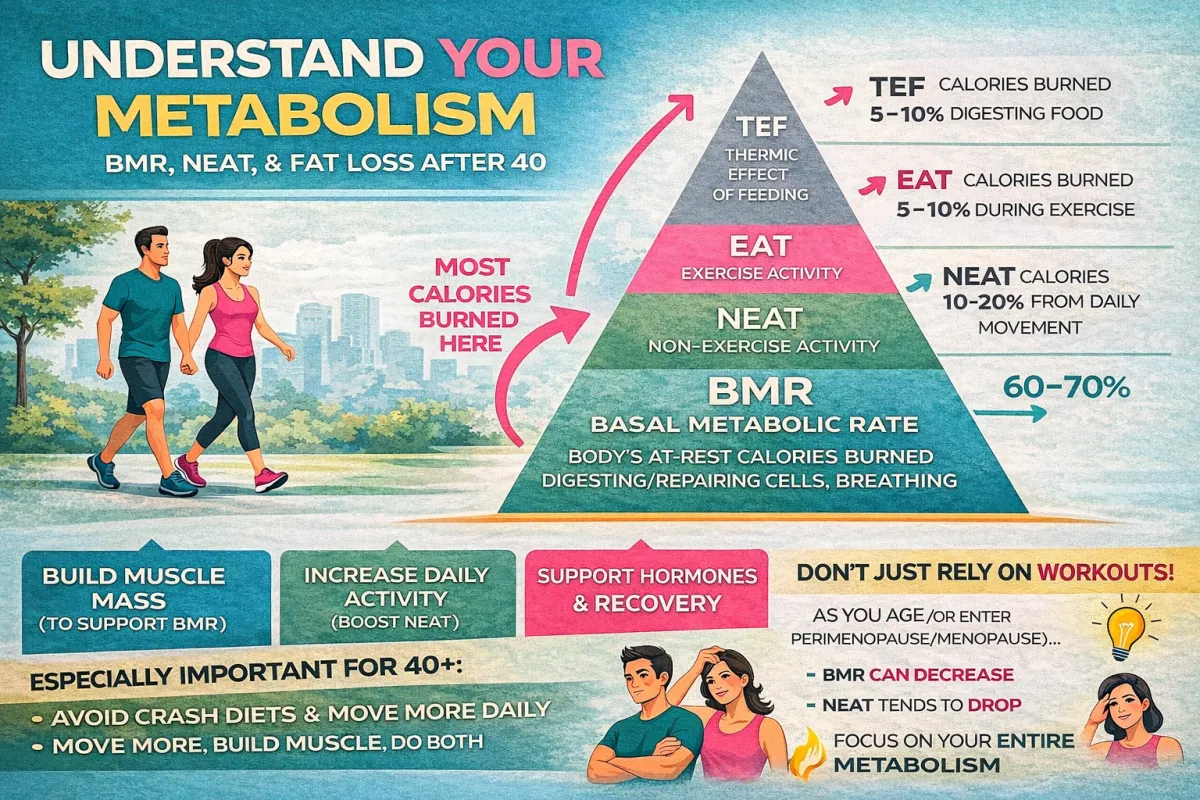
How This All Fits Together 👇
Here’s a visual that breaks it down really well:
BMR is the base (biggest chunk)
NEAT is the next biggest and the most within your control
Exercise is smaller than you think
Food digestion plays a small role
👉 Translation:
Your metabolism is built more on daily movement than workouts.
Why This Matters for Fat Loss
Most people try to lose weight by:
Eating less
Exercising more
But they ignore the biggest drivers:
👉 BMR + NEAT
And here’s what happens:
Dieting can slow your BMR (your body adapts)
You subconsciously move less → NEAT drops
Workouts alone don’t make up the difference
👉 Result: plateau city.
Why This Is Even More Important After 40
This is where things shift.
For both men and women:
Muscle mass naturally declines
Recovery takes longer
Metabolism becomes more sensitive to stress
For women in perimenopause & menopause:
Estrogen declines → impacts fat storage and insulin sensitivity
Muscle loss accelerates (if not strength training)
Cortisol tends to run higher → more fat storage, especially midsection
👉 Which directly affects your BMR
Because:
👉 Muscle = metabolic currency
The less muscle you have:
➡️ The lower your BMR
➡️ The fewer calories you burn at rest
The Big Problem Most People Miss
They focus on:
❌ More cardio
❌ Eating less
Instead of:
✅ Building/maintaining muscle (BMR)
✅ Moving more daily (NEAT)
How NEAT & BMR Work Together
Think of it like this:
BMR = your engine size
NEAT = how often you drive the car
You can have a great engine…
But if you barely move?
👉 You’re not burning much.
Or…
You can move all day…
But if your engine (muscle mass) is low?
👉 You’re still limited.
What You Should Actually Focus On
1. Strength Train (to support BMR)
2–3x per week minimum
👉 This helps preserve and build muscle
2. Increase NEAT (your secret weapon)
Walk more
Move between tasks
Stay active on “off days”
👉 This is where most fat loss actually happens
3. Support Recovery & Hormones
Especially for 40+:
Sleep
Stress management
Proper fueling (not under-eating)
4. Don’t Crash Diet
👉 Severe calorie cuts = lower BMR + lower NEAT
Your body adapts fast… and not in your favor.
Real Talk
If you’re over 40 and frustrated:
👉 It’s not that your body is broken.
👉 It’s that your strategy might be outdated.
You don’t need:
More workouts
More restriction
You need:
👉 A smarter approach to metabolism
The Takeaway
BMR is your foundation (keep muscle = keep metabolism)
NEAT is your superpower (move more, all day long)
Exercise supports both—but isn’t the whole answer
And if you start focusing on all three?
👉 That’s when things finally start to click.
If you want help understanding what’s happening with your metabolism, hormones, and daily habits…
👉 Check out the Nutrition & Lifestyle Audit:
https://inmotionbend.com/nutrition-Lifestyle-audit
Because once you understand your body…
You stop guessing—and start getting results.


